SORA RENTAL NOTE · 06
The lease gives one room number.
You live in a different room. What now?
Neither “It is the same building, so it is fine” nor “A different number means you lose all protection” is a safe assumption. First establish whether the building is dagagu (one building-level title) or dasedae (separately titled units).
Understand it through a comic
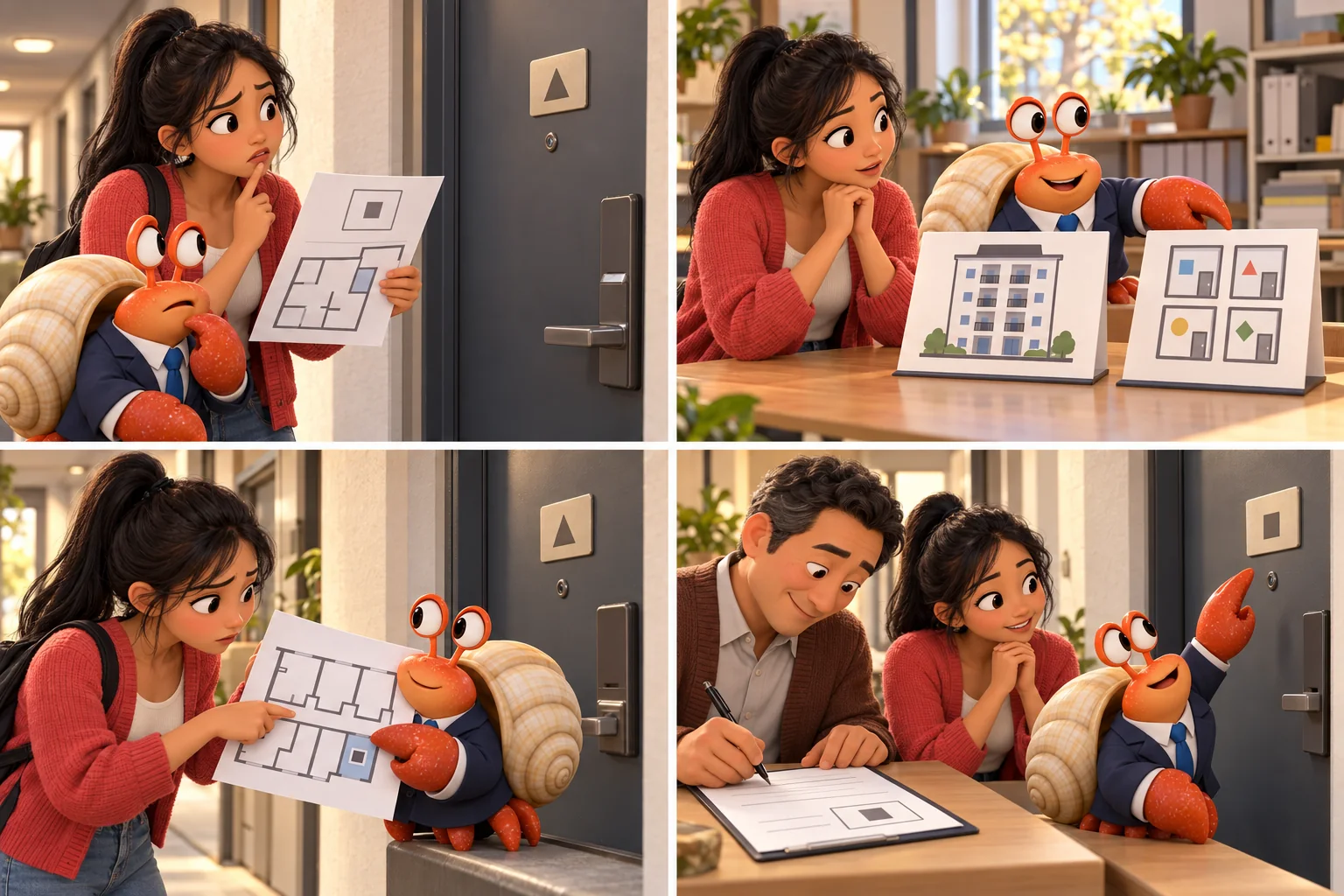
Ask about a mismatch immediately. “It is in the same building” is not enough to settle the issue.
How the address is assessed depends on the building’s legal type and the way the property is described in official records.
Check how the building and property records, lease, physical door label and registered address correspond.
Changing the door label alone is not enough. Identify the room’s official description and correct errors in the lease and registration.
This comic illustrates an example. Read the article below for the conditions and exceptions that apply.
THE SHORT ANSWER
Start with these three points.
- 01
Protection against third parties starts with possession and the required address registration.
Under Article 3 of the Housing Lease Protection Act, a tenant who takes possession of the home and completes resident registration acquires enforceability against third parties (대항력) from the following day under the current law. A move-in report is treated as satisfying the resident-registration requirement. This means that, once the legal conditions are met, the tenant can assert the lease against third parties such as a new owner.
For foreign tenants, use the address-registration procedure applicable to your status instead of assuming the Korean citizen procedure applies. Registered foreigners should check their foreigner registration and report of a change in place of stay; see guide 12 for the distinction and deadlines.
- 02
The address performs a different legal role in dagagu and dasedae buildings.
A dagagu building is usually registered as one property, so the accurate lot-number or road-name address identifying the building is central to giving public notice of the lease. Dasedae units are registered separately, making a match between the registered property’s building and unit numbers and the tenant’s registered address particularly important.
- 03
Possible protection under case law is different from safe everyday practice.
There are cases recognizing that, for a detached house used as a dagagu building, omitting or misstating an informally assigned room number does not by itself defeat enforceability if the accurate building address allows others to identify the lease. In a separately titled building such as dasedae, however, registering an incorrect number copied from the door may defeat enforceability if it differs from the official property description. As soon as you discover a mismatch, compare the official records with the actual space.
Important: Verify that the building is legally dagagu using the building register and certificate of registered matters, not a sign at the entrance or a property advertisement.
ONE BUILDING, DIFFERENT LEGAL MAP
Dagagu and dasedae buildings may look alike, but their legal structure differs.
- Whole-building records
- Individual unit title
| What to compare | Dagagu (다가구) | Dasedae (다세대) |
|---|---|---|
| Legal building type | A type of detached house used by multiple households | A type of collective housing |
| Property registration | Usually one registration for the entire building | Each household unit is registered as a separate exclusive unit |
| Address-registration focus | The accurate lot-number or road-name address identifying the building | The registered building address, building number and unit number |
| Risk of an incorrect unit number | Some cases recognize enforceability because the room is not an independently registered property, but the specific facts still need review | If the address appears to identify a different exclusive unit, public notice may be inadequate and enforceability is at significant risk |
| Safer action | First identify which space in the official records corresponds to the room actually handed over to you. Then check the lease and your registered address. Do not report an address based only on the number attached to the door. | |
201 OR 202?
The lease says Room 201, but you actually live in Room 202.
- Contract terms
- Actual building / unit
- Registered address
Identify the building type
Check the building register to see whether it is dagagu or dasedae, and the property register to see whether the units are separately titled.
Identify the space actually handed over
Keep photographs and a handover record showing the door and room for which you received the keys and which you exclusively occupy.
Correct the documents
After identifying the official description of the room you actually received, work with the landlord and agent to correct the leased-property description. If the door label is wrong, do not simply copy that number. Explain how the official records relate to the actual space to the community service center—or the authority handling your applicable foreign-resident registration—and check your registered address too.
Do not read dagagu case law as permission to write any room number.
- If the building address itself is wrong or you occupy a different building, that is a separate problem.
- Misidentifying a dasedae building as dagagu can change the legal outcome.
- Even apart from enforceability against third parties, an incorrect description of the rented property can cause a dispute between landlord and tenant.
CHECK BEFORE YOU RELY ON IT
As soon as you discover a mismatch, check these in order.
- 01Property records
- 02Actual home
- 03Check facts and correct
- Official records
Check both the building register and the certificate of registered matters.
Verify whether the building is dagagu or dasedae, its accurate location and whether the building and unit numbers refer to a separately registered unit.
- At the property
Match the door label to the room your key actually opens.
Check that the room shown to you when contracting, the room you moved into and the space identified on mail and utility records are the same.
- The lease
Correct the leased-property description to identify the space you actually occupy.
Do not rely on a verbal explanation. Keep a corrected contract or written confirmation bearing the parties’ signatures or seals.
- Address registration
Recheck the address in the completed registration record.
For Korean resident registration, check the recorded address through Government24 or the community service center against the official property records. Foreign tenants should check the equivalent record with the authority handling their registration. Ask promptly how to correct any error. If the earlier registration did not give valid public notice, correcting it does not retroactively put you ahead of rights that arose in the meantime. Review the earlier registered details and the dates when competing rights arose together.
- Evidence
Keep records showing the handover date and actual possession.
Records of receiving the keys, moving in, the entrance, management charges and utilities can help establish the facts if a dispute occurs.
FAQ
Frequently asked questions
Can a dagagu tenant register the address without a room number?
Some cases have held that, in a detached house used as a dagagu building, resident registration with the correct lot-number address does not lose its public-notice function merely because a room number is absent or differs from the actual room. The result still depends on the specific address and possession. It is safer to make the actual room and all documents correspond wherever possible.
Can I tell dagagu from dasedae by looking at the building?
It is difficult. Buildings containing several studios can look similar. Check the building register and certificate of registered matters.
Does address registration alone give me priority repayment of my deposit?
Address registration and possession are conditions for enforceability against third parties. For priority over later-ranking rights holders in a court auction or public sale, you generally need both the conditions for enforceability and a fixed date (확정일자). Check the fixed date separately too.
OFFICIAL SOURCES
Official materials checked
Current legislation and official institutional guidance were checked as of October 3, 2026.
- Korean Law Information Center · Housing Lease Protection Act, Article 3 Possession, resident registration and the conditions for enforceability against third parties↗
- Courts of Korea · Explanation of building and unit numbers in dagagu and dasedae address registration Legal effects of incorrect building or unit numbers according to building type↗
- Korea Housing & Urban Guarantee Corporation · Enforceability against third parties Possession, move-in registration and the basic conditions for protection↗
- Supreme Court, January 23, 1998, Case 97Da47828 Room-number descriptions and resident registration’s public-notice function in a detached house used as a dagagu building
- Supreme Court, April 12, 1996, Case 95Da55474 A case denying enforceability where registration followed a door label that differed from the official property description
This is general information based on legislation and official guidance checked on October 3, 2026, not legal advice. Enforceability against third parties depends on the building’s registration structure, the recorded address, actual possession and when competing rights arose, among other facts. For an important deposit dispute, obtain individual advice from a legal professional or the Housing Lease Dispute Mediation Committee, bringing the lease, address-registration record and property register.