SORA RENTAL NOTE · 32
They asked for a Korean resident register. What can I provide?
Learn when a Certificate of Alien Registration is the relevant document, how to request it and which recorded details to include.
Content checked · 3 October 2026
The key points
- Korean resident registration and foreign resident registration are different systems.
- A Certificate of Alien Registration can serve as the corresponding document in legally prescribed procedures and transactions.
- Choose the required recorded details; a certificate does not automatically establish eligibility for a benefit or housing program.
01 — 04
Start with the comic
Documents and screens are simplified illustrations. Check the sources below for actual forms and steps.
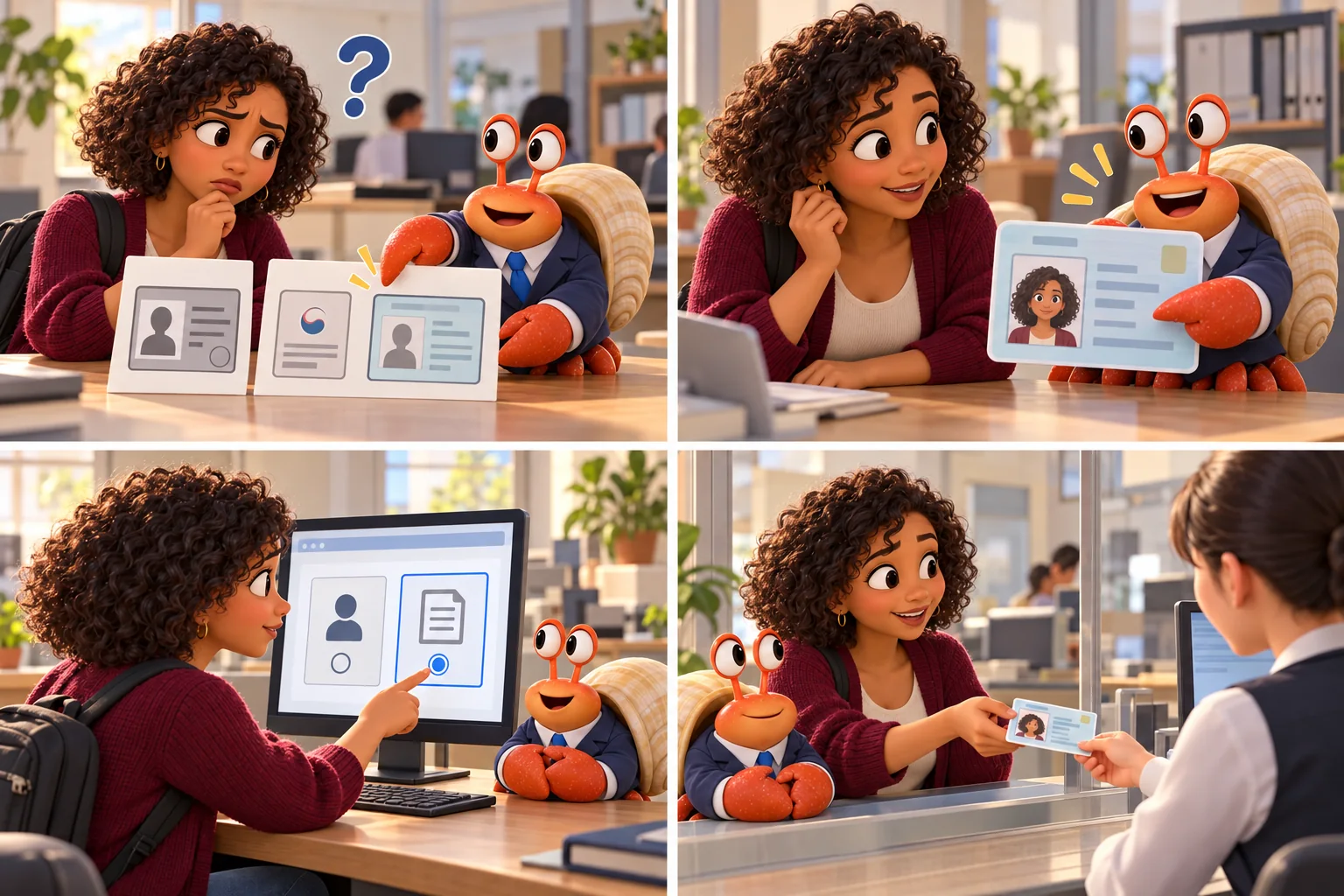
The checklist asks for a Korean resident register. What should I provide?
This card identifies you. Check whether a Certificate of Alien Registration is also needed.
I’ll find the certificate service and choose the required details.
At a service desk, show your ID to request the certificate.
Find the foreign resident’s corresponding document
- Residence records
- Certificate and contents
A Korean checklist may use the term 주민등록등본, a copy of the Korean resident register. If you are a registered foreign resident, do not assume you must somehow obtain the same citizen document. Explain that you hold a Residence Card and ask what facts the recipient needs to verify.
The Government24 foreigner guide explains that, in legally prescribed procedures and transactions requiring a resident registration card or register copy, the foreign registration card or Certificate of Alien Registration can serve as the substitute. The certificate’s Korean name is 외국인등록 사실증명. Keep that name available when speaking to a service desk.
Request the right certificate and the right information
- Certificate and contents
- Scope
- Responsible office
Government24 provides a certificate service. Its guide describes checking your registered name and number, choosing the recorded details and issuing the document. In-person channels include immigration offices and local community offices. If online identification fails, ask the relevant office about an in-person application instead of using another person’s login.
The guide shows options for current or previous addresses and recorded changes to names, registration numbers and stay status. Request the history needed for your purpose. For example, a recipient trying to connect an older name on a lease to your present identity may need name-change history; a certificate showing only your current details may not answer that question.
Document substitution does not remove other requirements
- Certificate and contents
- Protection requirements
- Legal requirements
Before applying, ask the recipient whether it needs a current address, past history, a particular issue date or a full identification number. Avoid sending every optional detail automatically. After issue, check the name, address and selected information, and use the official correction channel if something is inaccurate.
The certificate proves recorded registration facts. It does not make you a Korean citizen, establish ownership of a home or satisfy every housing-program condition. If an application separately requires a particular nationality, household status or income level, those conditions still need their own assessment.
What to check
- Tell the recipient you are a registered foreign resident and ask which facts it needs.
- Search for 외국인등록 사실증명 in Government24, or confirm an in-person issuing office.
- Select only the necessary current details and recorded histories.
- Check the issued information and the recipient’s format or issue-date requirements.
Common questions
Is my Residence Card always enough instead of a certificate?
Not necessarily. A card may identify you, while the recipient may need a certificate showing recorded history. Ask which facts and document format are required.
Will this certificate make me eligible for a Korean-only housing program?
No. Substituting an appropriate identity or registration document does not change the program’s nationality or other eligibility conditions.
Official sources
Korean laws and guidance from public agencies, universities and service providers. Most originals are in Korean or English. School and product examples apply only within their stated scope.