KOREA UNIVERSITY · EVERYDAY LIVING
Finding a Clinic or Medical Help Near Korea University
For a medical visit, check the facility, department, hours and language assistance before travelling. Routine appointments and emergency help require different approaches.
Last reviewed:
Sora-ge’s illustrated clinic guide
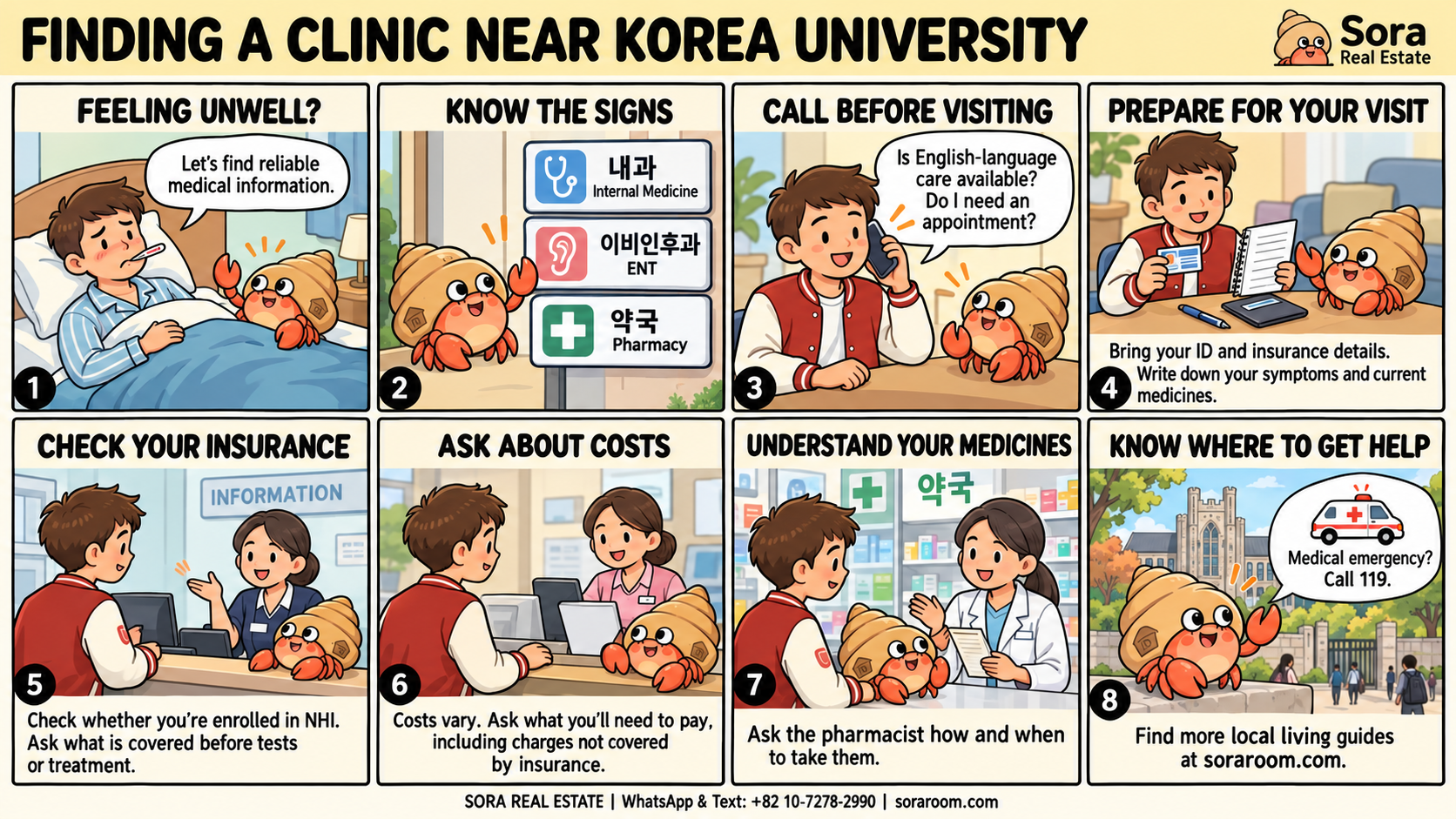
Eight steps for preparing for a medical visit. Check the detailed information and official sources below.
Read the comic as text
Feeling unwell?
Let’s find reliable medical information.
Know the signs
내과: Internal Medicine. 이비인후과: ENT. 약국: Pharmacy.
Call before visiting
Is English-language care available? Do I need an appointment?
Prepare for your visit
Bring your ID and insurance details. Write down your symptoms and current medicines.
Check your insurance
Check whether you’re enrolled in NHI. Ask what is covered before tests or treatment.
Ask about costs
Costs vary. Ask what you’ll need to pay, including charges not covered by insurance.
Understand your medicines
Ask the pharmacist how and when to take them.
Know where to get help
Medical emergency? Call 119. Find more local living guides at soraroom.com.
1. Emergency or routine visit?
- For immediate emergency help, call 119.
- For a non-emergency, identify the appropriate medical department and a nearby clinic or hospital that provides it.
2. Recognise Korean signs
- 의원 means clinic, 병원 means hospital and 종합병원 means general hospital.
- Useful department names include 내과 (internal medicine), 이비인후과 (ear, nose and throat), 피부과 (dermatology) and 치과 (dentistry). These labels help with searching; they are not a diagnosis.
3. Confirm language assistance
- Call to check reception hours, appointments or walk-ins, and support in your preferred language. Supported languages and hours differ by hospital.
- Seoul publishes medical-interpretation support information. Check eligibility, application requirements and current availability in advance; do not assume an interpreter is immediately available.
4. Evening, weekends and preparation
- Use the official E-Gen website to find hospitals and pharmacies, then call to confirm current reception hours before leaving.
- Save your Korean address and room number. A short note listing symptoms, medicines and allergies can help you communicate at reception.
5. Insurance and payment
- Check that your National Health Insurance (NHI) coverage is active with NHIS. If you use private or travel insurance, check its terms with your insurer.
- Ask the clinic what is covered, what you will need to pay and any non-covered charges before tests or treatment. Medical costs vary; NHI does not set one fixed price for every visit.
Useful Korean phrases
오늘 진료받을 수 있나요? 접수는 몇 시까지인가요?
Can I see a doctor today? What time does reception close?
영어로 진료 안내를 받을 수 있나요?
Can I receive guidance about the consultation in English?
건강보험이 적용되나요? 제가 부담할 금액은 얼마인가요?
Is this covered by National Health Insurance? How much will I need to pay?
Official sources
Some source pages are in Korean. Local rules and service conditions can change; check the linked source before acting.